Since 1 January 2026, a Finnish company can move its ownership into a US holding company without triggering an immediate capital gains charge for its shareholders. Finland extended its share exchange rules beyond the EEA through Act 1084/2025. Three conditions have to hold, and one common entity choice fails all by itself.
If you are working from advice written before 2026, it is out of date. That includes most of what is still indexed on this topic. This piece will age too, eventually.
Key points
- A share exchange into a US holding company can be tax-neutral if a tax treaty is in force, both companies are liable to at least 10% tax on income with no option or exemption, and both correspond in legal form to a Finnish limited liability company.
- A Delaware C-Corp meets the conditions. A Delaware LLC does not.
- The cash consideration cap rose from 10% to 50%.
- The relief is a deferral. Tax arrives when the US shares are sold.
- A founder who moves outside the EEA within five years of the exchange year triggers the deferred Finnish tax.
- Finnish transfer tax of 1.5% on fair market value still applies, and it falls on the US company.
What is a Delaware flip?
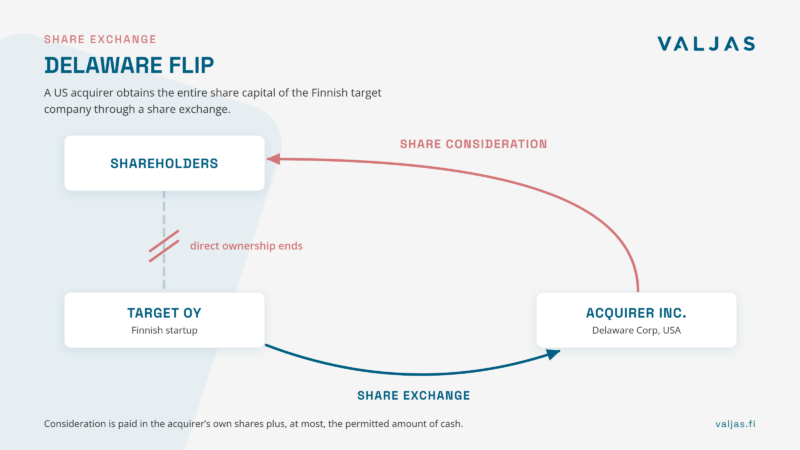
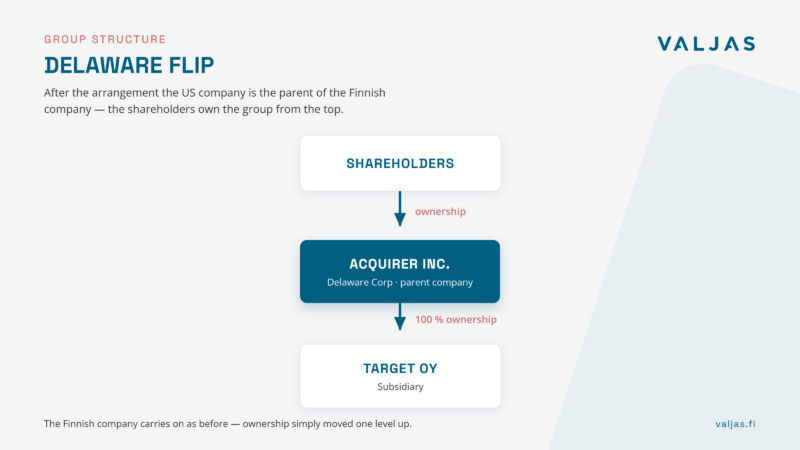
A Delaware flip is a restructuring in which the shareholders of a non-US company transfer their shares to a newly formed US holding company, receiving shares in that company in exchange. The original company becomes a subsidiary. In practice, the destination is almost always a Delaware corporation.
In Finnish tax law the transaction is a share exchange, osakevaihto. The word is worth knowing. It is the name of the relief, the heading in the Tax Administration’s guidance, and the term your Finnish advisers and any advance ruling application will use. “Delaware flip” is what the market calls it; osakevaihto is what the file will be called.
The driver is usually capital. Many US venture investors will not subscribe into a European entity, and Delaware is the legal environment their counsel and their LPs already understand. Local hiring, customer contracts and a future exit all get simpler on the same move.
What changed in Finland?
Before 2026, the flip was a taxable disposal for Finnish-resident shareholders. Finland’s share exchange relief in Section 52 f of the Business Income Tax Act (EVL) was tied to the EU Merger Directive and, through the freedom of establishment, extended to EEA states. It stopped there.
The Finnish Supreme Administrative Court confirmed this in KHO 2023:74. A US corporation acquiring the shares of a Finnish company fell outside the relief, and freedom of establishment did not help, because it does not cover a third-country company establishing itself in an EU member state.
So Finnish founders faced a capital gains charge on a transaction that produced no cash. Many worked around it by routing the flip through an intermediate EEA holding company in a state that did permit tax-neutral exchanges outside the EEA.
The Finnish government decided the workaround was the problem. Government Bill HE 125/2025 added a new subsection 3 to Section 52 EVL, extending the share exchange rules to non-EEA companies where three conditions are met:
- The company is resident in a state with which Finland has an income tax treaty in force for the tax year.
- The acquiring company and the target company are liable, without any option or exemption, to tax of at least 10% on their income in their state of residence. The test looks at the nominal rate.
- Both correspond in legal form to a Finnish limited liability company, assessed as an overall comparison of their civil law characteristics.
The same act raised the cash consideration ceiling from 10% to 50%, calculated against the subscription payment recorded in equity rather than share capital. Previously, if the subscription price went into the reserve for invested unrestricted equity, no cash could be paid at all without breaking the relief. Combining a share exchange with a partial cash buyout in one transaction is now workable.
The changes apply to share exchanges carried out on or after 1 January 2026. Anything earlier remains under the old law.
Does a Delaware corporation qualify?
An ordinary Delaware C-Corp meets all three conditions.
The Finland–US income tax treaty is in force. The federal corporate rate is 21%, comfortably above the 10% threshold. And a corporation formed under a US state statute is a per se corporation for US federal tax purposes, so it cannot elect a different classification.
Here is where structures go wrong: a Delaware LLC does not qualify. An LLC is a pass-through by default and has a classification election available to it. Condition two fails, and with it the entire relief. The same applies to an S-Corp election, though that route is closed to companies with non-resident alien shareholders anyway.
The entity comparison in condition three is an overall assessment. It looks at separate legal personality, limited shareholder liability, permanence of capital, management separate from owners, equal treatment of shareholders and free transferability of shares. A C-Corp satisfies these.
What does tax-free actually mean here?
It means deferral. The tax basis in the original shares carries over to the US shares, and the gain is taxed when those US shares are eventually sold.
The practical difference is still large. Take a company with a fair market value of EUR 1,000,000 and a founder holding 25% at nil basis. Under the old rules, the flip alone generated EUR 250,000 of Finnish capital income. The founder could not sell shares to pay the tax, because holding them was the entire point of the exercise.
That bill no longer arrives at signing. It arrives when there is cash to pay it.
When does Finland tax the deferred gain?
This is the trap that now matters most, and it lands on exactly the people who do flips.
Under Section 52 f(3) EVL, the deferred gain becomes taxable if the shareholder ceases to be EEA-resident before five years have passed from the end of the tax year in which the exchange took place. Finnish practitioners call this maastapoistumisverotus, exit taxation. Subsection 4 covers a second route: moving to another EEA state and then disposing of the consideration shares inside the same five-year window.
Note where the clock starts. A flip closing in June 2026 runs to the end of 2031, not to June 2031. If relocating to San Francisco or New York is anywhere in the plan, this belongs in the timeline before term sheets are signed, not after.
What else is payable?
Finnish transfer tax, varainsiirtovero. The transfer of Finnish company shares attracts 1.5%, and the 2026 reform left this untouched. At a EUR 1,000,000 valuation that is EUR 15,000.
The chain runs through Sections 15(1) and 15(3) of the Transfer Tax Act, which make a contribution of securities to a company against shares taxable, and Section 20(2), which sets the base at fair market value at the time of transfer rather than the stated consideration. The taxpayer is the acquiring company, meaning the Delaware entity.
Two practical points. The US company needs to register with the Finnish Tax Administration to obtain a reference number before it can file and pay, which is not a closing-week task. And under Section 16(2), where the transferor is Finnish tax resident and the recipient is not, the Finnish transferor carries a collection obligation and ultimate liability. Agree in advance who files.
One exception worth checking: under Section 16(1), no transfer tax is due if neither party is Finnish tax resident. On a cap table where every founder has already relocated, that can remove the charge entirely.
What can still break the deal?
The Delaware company must acquire more than half the voting rights in the Finnish company as part of the same transaction. A full flip clears this easily, but if a shareholder declines to participate, count the votes.
The anti-avoidance rule in Section 52 h EVL still applies. Where a share exchange is an interim step toward a rapid onward sale, the relief can be denied. KHO 2021:65 is the reference point.
And the cash consideration ceiling. The new 50% limit is generous, but exceeding it makes the exchange a taxable disposal for every participating shareholder, not just the ones who took cash.
Is a flip the right move at all?
If you are expanding into the US but not raising there, a subsidiary is enough. Incorporate under the Finnish parent, hire locally, keep the structure simple.
If you are raising in the US from the start, consider incorporating in Delaware first and forming the Finnish entity underneath. No flip, no exit tax exposure, at the cost of running two companies from day one.
The flip fits the case in between: the Finnish company already exists, and an investor requires a US structure. That is now genuinely available without the founders funding a tax bill out of money that does not exist yet.
FAQ
Does this apply to flips completed before 2026? No. The EVL amendments apply to share exchanges carried out on or after 1 January 2026. Earlier transactions remain governed by KHO 2023:74 and are taxable disposals.
Can we flip into a Delaware LLC? No. An LLC has a classification election available, so the second condition in Section 52(3) EVL fails. Use a C-Corp.
What if only some shareholders are Finnish tax residents? The relief applies to the Finnish-resident shareholders. Participation by shareholders resident outside the EU or EEA does not prevent the share exchange rules from applying, and the Finnish rules simply govern the Finnish-resident holders. Everyone else is assessed under their own jurisdiction.
Should we apply for an advance ruling? We recommend it. The provision is new, the entity comparison is an overall assessment, and there is no case law yet. An advance ruling from the Finnish Tax Administration, an ennakkoratkaisu, costs a fraction of a wrong interpretation.
What if a founder has already moved to the US? Then they are no longer a Finnish tax resident, and their position is assessed under the tax treaty rather than under domestic Finnish rules. Worth settling case by case before the restructuring starts, not after.
Does this say anything about US tax treatment? No. This covers the Finnish side only. The US treatment of the flip, and the position in any other jurisdiction where shareholders are resident, needs separate local advice.
Did anything else change in the same act? Yes. Where a share exchange takes place between related parties, the acquiring company now values the target shares at their pre-exchange mathematical value, a net-asset-based figure used in Finnish dividend taxation, rather than at fair market value. That tightens dividend taxation in domestic holding structures and reaches back to exchanges from 2017 onward. Different topic, different audience, no bearing on a Delaware flip.
The Finnish terms you will hear
Useful if you are running this with Finnish advisers or reading Finnish documents.
Finnish – English
osakevaihto – share exchange
elinkeinoverolaki (EVL) – Business Income Tax Act
varainsiirtovero – transfer tax
maastapoistumisverotus – exit taxation
ennakkoratkaisu – advance ruling
käypä arvo- fair market value
hankintameno – tax basis, acquisition cost
luovutusvoitto – capital gain
The Delaware flip is no longer a tax trap in Finland. It is not a routine filing either. Entity type, timing, relocation plans and transfer tax all need to be settled before the first signature.
If a flip is on the table, talk to us while the term sheet is still in draft. We will walk through the structure and tell you what it costs and in what order to do things.
This article reflects Finnish law as of August 2026. It is general information and does not replace advice on your specific situation.